
Week 7 – Modes of Dissemination
- Jesse Cather-Long

- Mar 23, 2023
- 3 min read
Updated: Jul 3
Week 7 looked at modes of dissemination, for example an exhibition or a photobook. Traditionally, exhibitions will be a series of photographs in a room with bright white lighting, they aren’t accessible and many find difficulties visiting them. However, in recent times with the Covid-19 pandemic changing the way the world is run, many exhibitions moved online. “For gallerists and curators, the online show has some fundamental benefits: it offers a reach that a physical exhibition can not.” (Duzant, 2020)
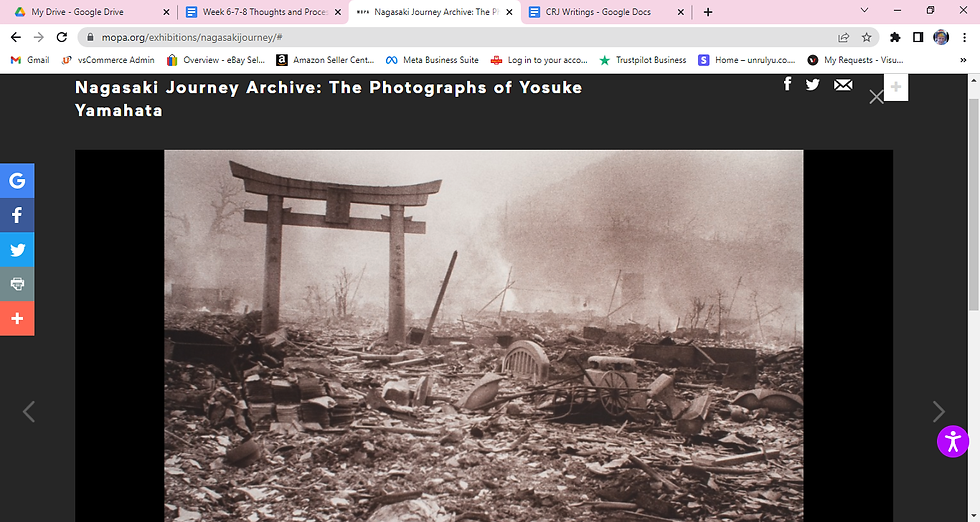
When looking at these online exhibitions, a large amount of them look like this exhibition hosted by MOPA:
(MOPA, 2023)
The image is on a basic dark background, with a title, and arrows to flick through the images in the order that the artist has chosen you to see them. There is a share button for social media, and not a whole lot else.
The PH Museum has an exhibition on portrait photography showing on their site, presence:

(PH, 2023)
This exhibition shows the images as a collage which you scroll through. Dotted throughout the page is text that gives facts and explains the exhibition. An audience can choose where they look, they have multiple images shown to them at once and they are able to have their eyes guide them through the images, much like you would in an exhibition.
Overall, people do not like change, therefore the online exhibitions that can make an audience feel as if they are in a physical gallery should be the more successful ones. Photo London has taken this to the extreme, using technology to completely map each room in their physical exhibition. Users online can move through the rooms and look at the artwork as they would if they were there. There is, however, another way to have this experience without needing a physical exhibition and a 360 camera. The interactive exhibition.
Interactive exhibitions isn’t an entirely new process, throughout the 00s, Joel Walker had multiple interactive exhibitions where the audience was encouraged to connect with their emotions. He started this because during his therapy sessions, he found his patients using his images to convey their emotions. “I was intrigued at how images could enhance their awareness and overcome resistance; exploration of underlying feelings and core conflicts was enhanced.” (Wald et al., 2010). Interactive exhibits give an audience a chance to connect with the images and become closer to the overall message. Adding the accessibility of an online exhibition could have brilliant outcomes for connecting with an audience.
A great example of this is Format’s photography festival in collaboration with New Art City. Their ‘rooms’ are entirely interactive, with the ability to look in every direction, move in every direction, and having the ability to click onto images for full information and captions, but the title of the image/collection is available just by looking at it. The website has a guest book, as well as an easy to use interface.

(Format, 2021)
I believe interactive online exhibitions could be an important next step into having the art world be more accessible to all, and be able to keep the unique audience connections that traditional exhibitions give.
References:
Duzant, M. (2020) Virtual Exhibitions: Digital Spaces, open possibilities – photographs by various artists: Essay by Magali Duzant, LensCulture. Available at: https://www.lensculture.com/articles/online-exhibitions-virtual-exhibitions-digital-spaces-open-possibilities (Accessed: March 22, 2023).
Format, F. (2021) Information centre, by Format21 Photography Festival, FORMAT21 Info Centre. Available at: https://format.newart.city/ (Accessed: March 22, 2023).
MOPA (2023) Nagasaki Journey Archive: The photographs of Yosuke Yamahata, Museum of Photographic Arts (MOPA). Available at: https://mopa.org/exhibitions/nagasakijourney/# (Accessed: March 22, 2023).
PH, M. (2023) Presence, PRESENCE. Available at: https://presence.phmuseum.com/?_gl=1%2A1oqfbvt%2A_ga%2AMTUyMTQ1NTYyMi4xNjc4MjA2Njg3%2A_ga_V4VVR5SB9P%2AMTY3ODIwNjY4Ny4xLjEuMTY3ODIwNjY5NS41Mi4wLjA (Accessed: March 22, 2023).
Wald, H.S., Norman, D.R. and Walker, J. (2010) “Reflection through the arts: Focus on photography to foster reflection in a health care context.living beyond– an interactive photographic exhibit,” Reflective Practice, 11(4), pp. 545–563. Available at: https://doi.org/10.1080/14623943.2010.505720.


Comments