
Week 10 – Photography and Objectivity – Truth and Fiction
- Jesse Cather-Long

- Apr 16, 2023
- 3 min read
Updated: Jul 3
During this week, I spent a lot of time looking at my self-directed project. I went on a number of shoots.
Choosing what images to edit to a shortlist:


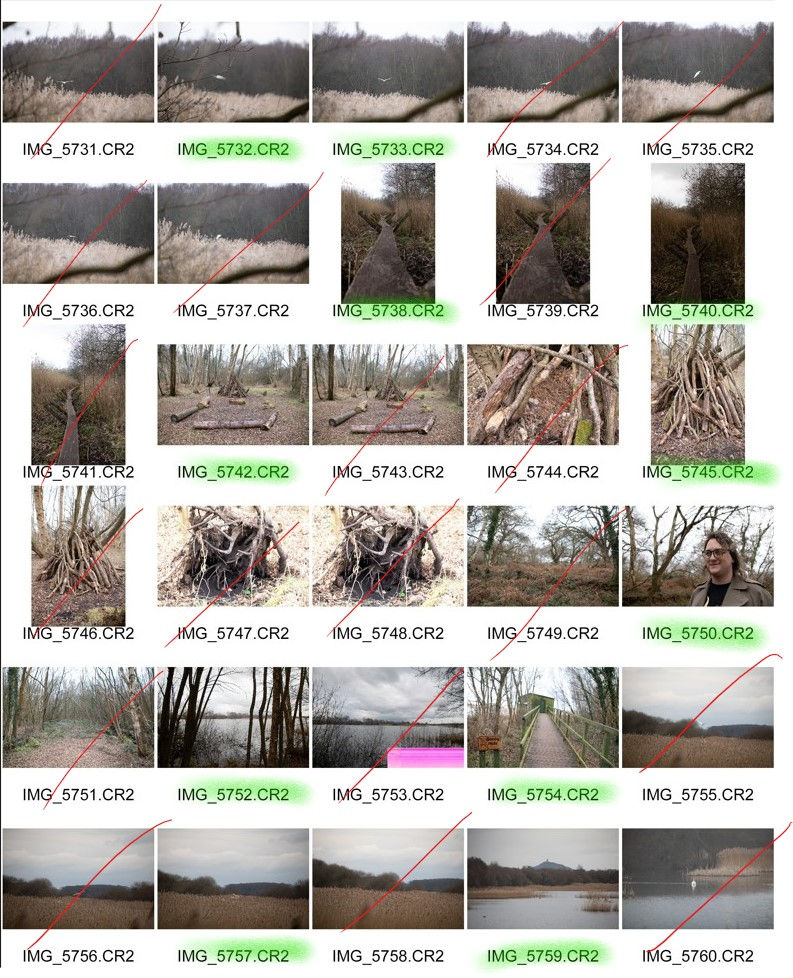


Choosing from the short list which images to include in the project:
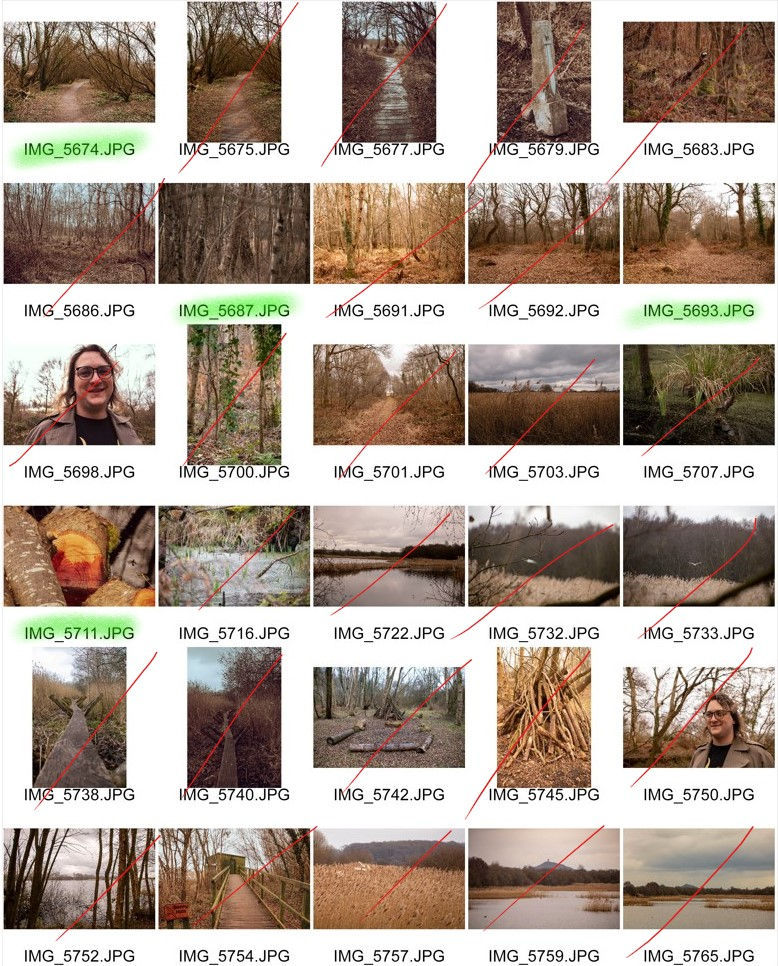


The final 20 images:
I had to change my plans on where I was going to shoot due to the weather, and travel restrictions. I also wanted the final map to look populated, and not have large gaps, so I cancelled one shoot and added another in order to have a better looking map. I also set up the map on my website so that it is ready to have the images added once I have added the sound.

During this week’s webinar, I suggested the idea of recording music to have in the background so that quiet moments are populated. My peers told me that they thought background music could be overpowering, and suggested that I keep it plain, or use sounds of walking, or birds. I think that I will look at the final product with no added background noise, and decide at that point if it works.
I also got some feedback from my peers who suggested that I swapped some of the images around so that there was less repetition in the style whilst it still stayed cohesive. I was also suggested to add some saturation to one image to make it look more like the other images, which I did.
This week, we also looked at the philosophy surrounding the truth in photography. In the modern day people often question the truth in photography as there are so many ways to manipulate a photograph. There are photographers who take this to the next level by purposefully creating images that raises questions.
One example is Sasha Goldberger, especially their series Super Flemish. In this series they take superheroes and photograph them in a 15th century style. My favourite of this series is of Iron Man, pictured below with the characters modern look and comic looks:


The photographs style is reminiscent of the Flemish painters, such as Jan van Eyck and Peter Paul Rubens. This style of painting would “portray a robust and realistically detailed vision of the world around them.” (Britannica, 2023) A person who doesn’t know who Iron Man is, or what flemish paintings are would likely be able to see that the past and the present has been mixed, and have a basic understanding of what the image is, as “a specific photograph, in effect, is never distinguished from its referent” (Bathes, 1993). With this kind of photography, Goldberger is “demonstrating the possibilities that lie within thoughtful, explorative, and witty manipulation.” (McCaster, 2015)
Whilst Goldberger manipulated their images through pre-production, Erik Johansson uses image manipulation software to change his images post-production, turning them into unreal scenes:


Johansson makes a person question the image, because he aims to keep a sense of realism in his work. The image will be composed of multiple photographs put together to create something that looks as though it’s real, but you know it can’t be. “When you take a photograph with a camera, the process ends when you press the trigger… I wanted to create something different, something where the process starts when you press the trigger” (Johansson, 2011) This level of manipulation in an image shows that what you’re seeing is a pre-planned artistic image, however due to the creative choices he makes, these images could, at a first glance, be mistaken for a landscape image, taken straight from the camera with no manipulation.
References:
Barthes, R. (1993) Camera lucida. Vintage.
Britannica, E. (2023) Flemish art, Encyclopædia Britannica. Encyclopædia Britannica, inc. Available at: https://www.britannica.com/art/Flemish-art (Accessed: April 13, 2023).
Goldberger, S. (2015) Super Flemish, Bored Panda. Available at: https://static.boredpanda.com/blog/wp-content/uploads/2014/11/16th-century-super-heroes-10.jpg (Accessed: April 13, 2023).
Johansson, E. (2008) Go Your Own Road, Erik Johansson. Available at: https://images.squarespace-cdn.com/content/v1/554b5e7ce4b0149371f10a93/1500971094885-UVO7ALGK37D2EW1C52OS/go-your-own-road-Erik-Johansson.jpg?format=1500w (Accessed: April 13, 2023).
Johansson, E. (2011) Impossible photography, Erik Johansson: Impossible photography | TED Talk. TED. Available at: https://www.ted.com/talks/erik_johansson_impossible_photography (Accessed: April 13, 2023).
Johansson, E. (2021) Grow With Progress, Erik Johansson. Available at: https://images.squarespace-cdn.com/content/v1/554b5e7ce4b0149371f10a93/1635339376643-3R250R63FEWLCX9IGWXN/image-asset.jpeg?format=750w (Accessed: April 13, 2023).
Knauf, D. et al. (2008) The invincible iron man. New York, NY: Marvel Pub.
Lee, S. (1963) Tales of suspense, no. 39. New York, NY: Marvel Comics.
Lee, S. (2008) Iron Man, MCU Wiki. Available at: https://static.wikia.nocookie.net/marvelcinematicuniverse/images/a/a0/Iron_Man_Armor_-_Mark_L.png/revision/latest?cb=20180318221316 (Accessed: April 13, 2023).
McMaster, S.R. (2015) “Truth in photography: How I learned to stop worrying and press the shutter,” The International Journal of the Image, 8(2), pp. 77–98. Available at: https://doi.org/10.18848/2154-8560/cgp/v08i02/77-98.


Comments